Coronary Angioplasty
Pre-Operative Assessment
Before having a coronary angioplasty, you’ll have a complete pre-operative assessment to make sure the procedure can be carried out safely and it is in your best interest to have this operation.
During this assessment, you will have ample opportunity to discuss with me details of the procedure, alternatives to this treatment and any concerns you may have. In this visit, you will also have blood tests and a general health check to ensure you’re suitable for surgery.
Most often you would already have had a procedure called a coronary angiogram before your angioplasty. An angiogram is done first to look inside your arteries to check where the blockages are. (Please click here to know more about a coronary angiogram). Sometimes I will do the angiogram first and then continue on to do the angioplasty as part of the same procedure.
Pre-Operative Preparation
- Do not eat or drink anything from midnight the day of the procedure.
- You may take your usual medications early in the morning with half a glass of water.
- If you are on blood-thinning medications (warfarin, dabigatran, apixaban, rivaroxaban or edoxaban), you need to stop these for a period (usually 2 days) that I will specify at the pre-op visit.
- Alter the timing of any diabetes medication—particularly insulin—ask the team before taking your morning dose.
- The area of access (wrist or groin) will be cleaned and shaved of any hair.
- Use the restroom before coming to the procedure room as you’ll need to lie flat during the procedure.
- The nursing/para-clinical team will conduct a checklist before you are taken to the cath lab—ask them any doubts you may have.
During the Procedure
A coronary angioplasty usually takes place in a catheterization lab equipped with X-ray imaging. It takes between 30 minutes and 2 hours.
- You’ll lie on your back on an X-ray table, attached to heart monitor, BP cuff, and Pulse Oxymeter.
- The procedure is done under local anaesthetic. An IV line is inserted for fluids or medication.
- A small incision is made in your wrist, groin, or arm to insert a sheath into an artery.
- A catheter is passed through the sheath into the coronary artery.
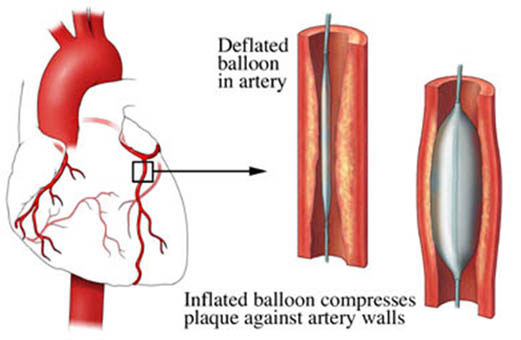
- A wire is used to position a balloon which inflates to compress plaque and open the artery. This may cause temporary chest pain.
If a stent is required, it is mounted on the balloon and left in the artery after the balloon is deflated. The procedure ends with removal of all instruments and control of bleeding via a plug or pressure.
Going Home
You’ll likely stay overnight in hospital. Avoid strenuous activity and driving for one week. After this, most normal activities can resume and some medications may be reduced.
Coronary Stents Explained
- Bare Metal Stents: Uncoated, more likely to provoke immune response and re-narrowing.
- Drug-Eluting Stents: Coated with medications to reduce the risk of re-blockage, but delay healing—requires dual anti-platelet therapy for up to a year.
Medications in stents include "Limus" types (sirolimus, everolimus, zotarolimus) and Paclitaxel, used in chemotherapy.
Case Examples
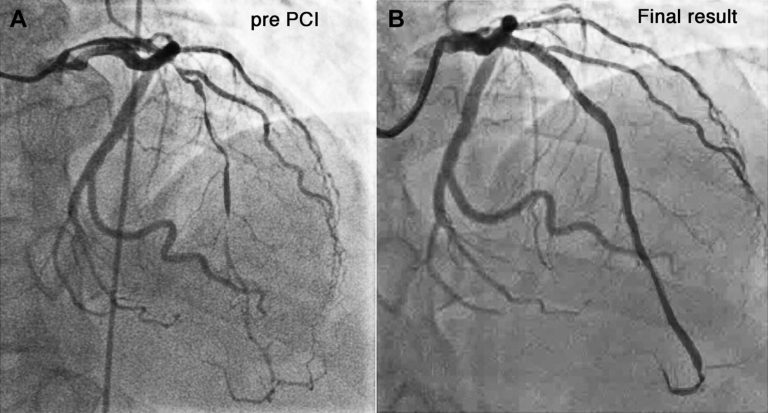
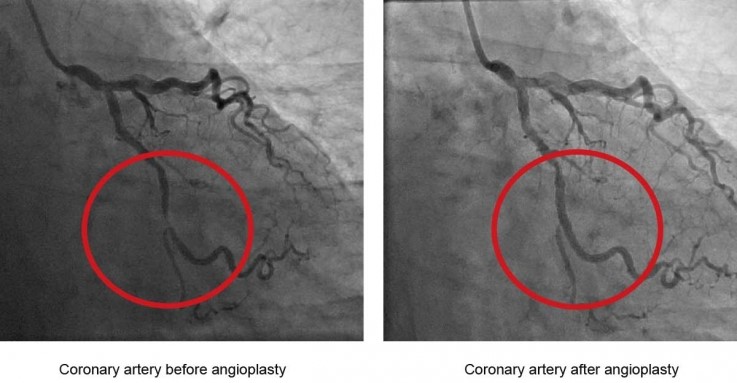
- Right Coronary Artery Stenting - Before and After
- Reconstruction of a Completely Occluded (CTO) Right Coronary Artery
- Angioplasty with Stenting of Left Circumflex Coronary Artery
- Angioplasty and Stenting of Near Total Occlusion with Long Stenosis in Left Anterior Descending Coronary Artery